
By: Joel A’Bell
Imagine walking for 7 hours each day in the scorching heat just to collect water.
My own two children are grown up now, but I’m constantly reminded of just how beautifully chaotic, exhausting, and all-consuming those early years of parenting are when spending time with our grandkids
These days, my wife and I get the joy of being Ma and Pa to our daughter’s two-year-old son and twin baby daughters. Whenever I visit them, my heart is reminded of how fragile, precious, and completely dependent little children are on us to keep them safe.
Each morning, I watch Harmony in the kitchen making her girls’ bottles or filling up her son’s drink bottle. She turns the tap on, water flows instantly, and she fills the kettle or drink bottle and moves on to the next task.
Which is why when I went to Tanzania, the different reality for mothers hit home.
Thinking back on my trip…
Visiting a school in the region of Simanjiro, I’m surrounded by dry, dusty earth under a blazing sun. And as a grandfather, my heart is heavy with a contrast that I just can’t shake.
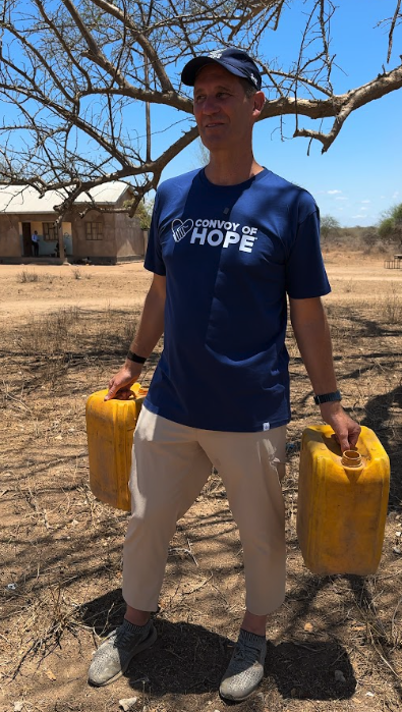
[Photo of Joel A’Bell in Simanjiro, Tanzania with two yellow jerry cans]
Here I’m holding two yellow jerry cans. The type you might find in your local Bunnings. Empty, they weigh next to nothing. But filled up? They hold 20 litres of water each. That’s about 20 kilos I’m holding in each hand.
As a grown man, I can lift these. But imagine a young mother or girl, maybe the same age as your daughter or granddaughter, carrying that crushing weight.
Worse yet, imagine the distance she must walk each day to bring water home for her family.
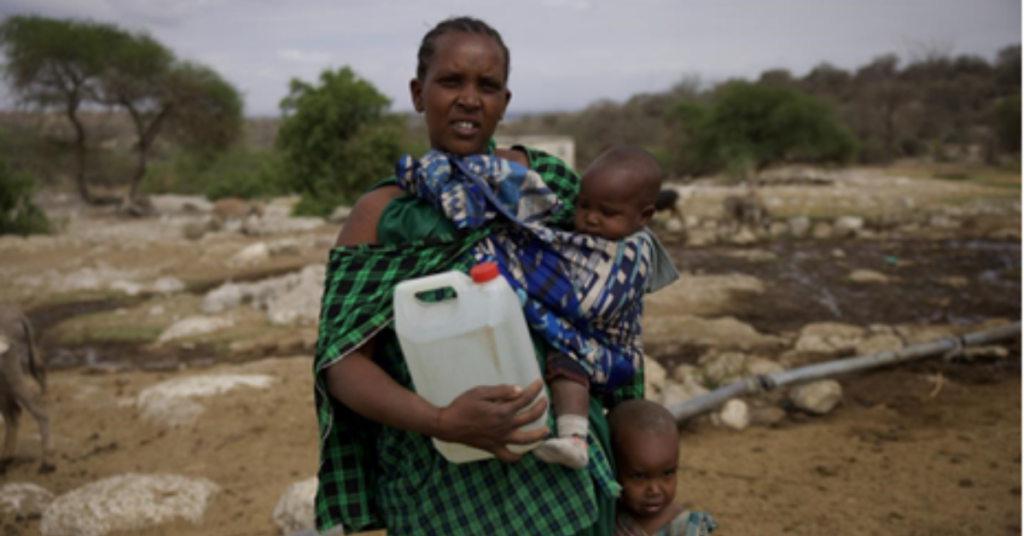
I met a mother named Nangida who walks ten kilometres twice a day to the nearest source of water. The journey is hard, with a baby on her back and a toddler whose little legs can’t keep up. She relies on her eight-year-old daughter Sophie to help, feeling guilty that she misses school because of it.
[Nangida (above) walks ten kilometres twice a day with her children to collect water.]
Think about that for a moment. To get enough water just to survive, Nangida and her children are walking up to 7 hours a day in the scorching heat. To get water that they need to survive, but that could also make them sick.
The community here is incredibly resilient. Like my daughter, Nangida has dreams for her children’s future.
Harmony wants her children to learn, play and grow. The families here want the exact same thing. They don’t want handouts; they simply want access to water so they drink, cook food and grow crops for themselves. They want their daughters to stay in the classroom, not walk half the day for water that isn’t even safe to drink.
It feels overwhelming, doesn’t it? But the solution is simple.
When a community gets access to clean water right where they live, the cycle of poverty breaks instantly:
- Young girls can drop the heavy jerry cans and stay in school to get an education.
- Children no longer get sick or die from water filled with bacteria and parasites.
- Families can start farming, planting crops, and generating an income.
Let’s use what we have been given to give these children the future they deserve. You can donate here.
Article supplied with thanks to Convoy of Hope
National Director, Convoy of Hope Australia and New Zealand
Feature image: Supplied